


 |
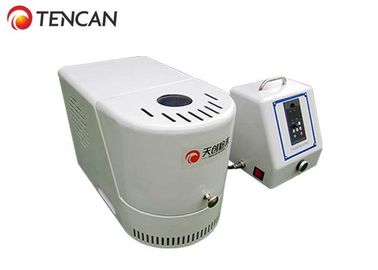
Lab 50Hz Nano Powder Making Benchtop Planetary Ball Mill 90W In Glove Box
Product Details:
| Place of Origin: | Hunan, China |
| Brand Name: | TENCAN |
| Certification: | CE ISO |
| Model Number: | XQM-0.2S |
Payment & Shipping Terms:
| Minimum Order Quantity: | 1 set |
|---|---|
| Price: | Negotiable |
| Packaging Details: | Plywood Case |
| Delivery Time: | 3-7 working days after getting full payment |
| Payment Terms: | T/T,Western Union |
| Supply Ability: | 200 sets per |
|
Detail Information |
|||
| Product Name: | Super Mini Bench-top Laboratory Ball Mill | Model No.: | XQM-0.2S |
|---|---|---|---|
| Voltage: | 110V-60Hz Or 220-50Hz | Power: | 90W |
| Weight: | 24KGS | Magnification Times: | 120-1160 Rpm |
| Dimensions: | 220*410*270mm | Net Weight: | Frequency Control |
| Highlight: | 50Hz Planetary Ball Mill,90W Planetary Ball Mill,Glove Box Benchtop Ball Mill |
||
Product Description
China Tencan 0.2L 110V or 220V Laboratory Nano Powder Making Bench-top Ball Mill
Overview

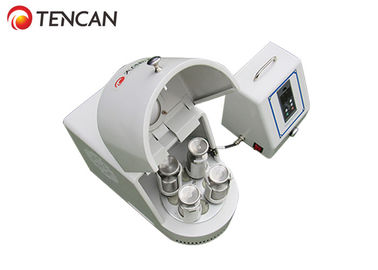
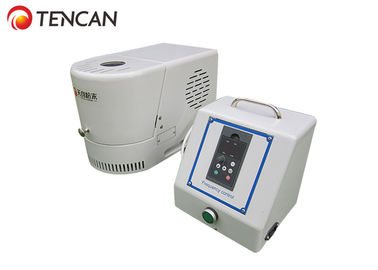
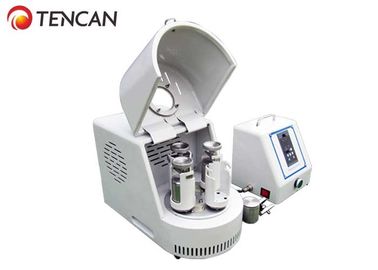
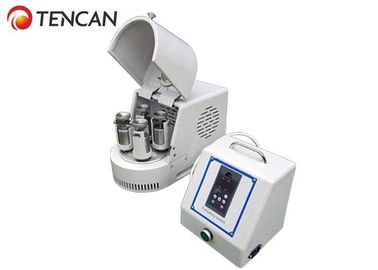
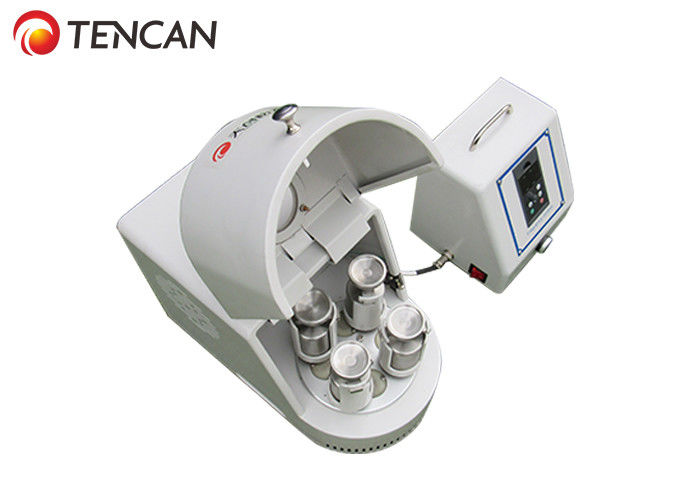
Vertical planetary ball mill is a necessary device of high-tech materials mixing, fine grinding, sample making, new product development and small batch production. Tencan planetary ball mill owns small volume, high efficiency, low noise and functional features which is a ideal equipment for R&D centers, universities, enterprises laboratory to get samples (each experiment can get four samples at the same time). It can be put into the glove box and grind any materials which have to be operated under the vacuum state or inert gas atmosphere inside the glove box.
Working Principle
Planetary Ball Mill has four ball grinding tanks installed on one turntable. When the turntable rotates, the tank axis makes planetary movements, the balls and samples inside the tanks are impacted strongly in high speed movement, and samples are eventually ground into powder. Various kinds of different materials can be ground by the mill with dry or wet method. Minimum granularity of ground powder can be as small as 0.1µm.
Applications:
XQM-0.2S is a kind of supper mini model of vertical planetary ball mill which is specially designed to be used for grinding materials under vacuum or inert gas atmosphere conditions inside the glove box.
Features
1.Stable revolving speed of the gear transmission ensures the consistency and repeatability of the experiment.
2. Planetary movement principle is adopted in the machine, which has high speed, large energy, high efficiency, small granularity.
3. Four powder samples from different sizes and different materials can be produced at one time.
4. The machine is controlled by frequency converter, you may set ideal rotating speed according to expected experimental result. The converter is equipped with device of under voltage and over-current to protect the motor.
5. The planetary ball mill has functions of timing power off, self-timing forward and reversal rotating. You may select any operation modes of one-way direction, alternation, succession, time setting according to experimental needs, so as to improve efficiency of grinding.
6. Technical features of XQM-2S: small volume, more functions,low center of gravity, stable performance, compact structure, easy operation, reliable safety, lower noise, small loss.
Technical Parameters
| Drive Mode | Gear drive or belt drive |
| Operation Mode | Two or four grinding tanks working together |
| Max Load Capacity | Less than 2/3 of total volume of grinding jars |
| Feed Size of Materials | ≤3mm |
| Output Granule | Minimum 0.1µm |
| Rotational Speed Ratio | 1/2 |
| Max.Continuous Operating Time | 72 Hours |
| Materials of Jar | stainless steel.agate,nylon,corundum, zirconia,etc |
| Super Mini Planetary Ball Mill For Glove Box Use | ||||||||
| Model No. | Voltage | Power (W) |
Revolution Speed (rpm) |
Rotation Speed (rpm) |
Inner Diameter of Jar Holder (mm) |
Max Height of Jar (mm) |
Outline dimension (mm) |
Net Weight (KGS) |
| XQM-0.2S | 110V/50Hz,60Hz or 220V/50Hz for buyer option |
90 | 60-580 | 120-1160 | 50 | 60 | 220*410*270 | 24 |
Accessories Available for Mini Size Laboratory Bench-top Ball Mill
We provide all kinds of mill pots in any matched size, which are made from following materials of agate, Alumina corundum ceramics, zirconia ceramics, silicon nitride ceramics, carborundum ceramics, stainless steel, high wear resistant steel, manganese steel, nylon, PU, cemented carbide, crystal glass, and etc.
We can also provide all kinds of mill balls like stainless steel balls, zirconia balls, alumina balls, PU balls, steel carbon balls, tungsten balls, agate balls, hard metal balls, silicon nitride balls, high wear resistant steel ball, manganese steel balls, nylon balls, cemented carbide, crystal glass and other special metal materials.
A Mill Designed to Live Inside a Glove Box
Most laboratory mills are sized for a bench, not for the inside of a glove box. The XQM-0.2S is the exception: it measures just 220 x 410 x 270 mm and weighs 24 kg, small enough to be lifted through an antechamber and placed on the floor of a glove box, where it can be operated without breaking the inert atmosphere. Its low drive power of 90 W suits this setting, since a mill running inside a sealed enclosure must not add much heat or draw a heavy load. The jars are small - held in a 50 mm holder with a maximum jar height of 60 mm - which keeps the whole operation within arm's reach. For a laboratory working with air-sensitive materials, having the mill inside the box removes the need to move samples in and out.
Grinding Oxygen- and Moisture-Sensitive Powders
Some powders cannot be handled in open air at all. Fine metal powders such as aluminium, lithium compounds, certain catalysts and reactive alloys will oxidise, hydrolyse or even ignite on contact with oxygen or moisture, and the very act of grinding exposes a large fresh surface to the atmosphere. The usual answer is to keep the whole process in an inert atmosphere, and the XQM-0.2S is built for exactly that: it grinds inside a glove box, under vacuum or under an inert gas such as argon or nitrogen. Working this way preserves the chemistry of the sample as well as its particle size, which matters when the powder's properties depend on its surface. The small batch size suits precious or hazardous materials, where only a few grams are needed and contamination or loss would be costly.
Fitting Jars into a 50 mm Holder: Small Jars for Small Samples
A super-mini mill uses small jars, and its holder sets the limit. The XQM-0.2S carries jars up to 50 mm across and 60 mm tall, which covers the modest sizes used for small samples, with a working charge kept below two thirds of the jar. Because the jars are small, media should be small too: a few millimetres is a sensible starting point, small enough to fit the jar with room to move but heavy enough to do the work. Matching the jar material to the sample follows the same logic as on a full-size mill - agate or zirconia where contamination must be avoided, stainless steel where a little iron pickup is acceptable. For reference work, the small jars also make it practical to run several jars of the same material for repeat measurements.
What a 0.2 L Super-Mini Mill Is Good For
With only 0.2 L of total volume, the XQM-0.2S is not a production machine, and it is not meant to be. It exists for the cases where a full-size mill is simply too much: developing a new material when only a gram or two is available, preparing a specimen for analysis, or studying a reaction that must be observed on a very small scale. The small charge is an advantage rather than a drawback here, because it lets a scarce or expensive sample be ground without waste, and it keeps the experiment quick - a small jar heats and cools faster, so runs can be shorter and repeated more often in a day. It is the benchtop companion to a larger mill: use the mini model to establish a method and check a result, then move to a larger machine when the quantity grows.
Keeping the Sample Airtight: Vacuum Jars and Sealed Transfer
Working inside a glove box changes how the sample is moved, and the small jars of the XQM-0.2S make that easier to manage. Vacuum jars allow grinding to be carried out with the powder sealed from the surrounding atmosphere, which is useful when a material must stay free of air even during milling. Once a run is finished, the jar can be closed and passed out through the antechamber without the powder ever meeting open air, so the sample arrives at the next step - weighing, analysis or storage - in the same condition it was milled. Keeping a set of jars dedicated to a single material also avoids cross-contamination between experiments. Handled this way, the mill and the glove box together form a closed path from raw powder to finished sample.