


 |
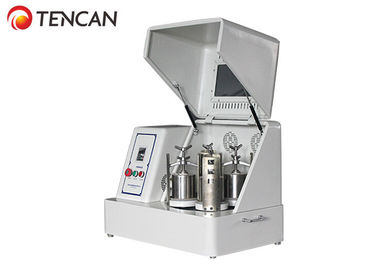
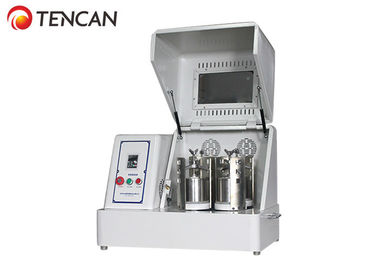
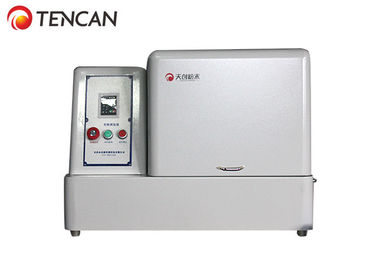
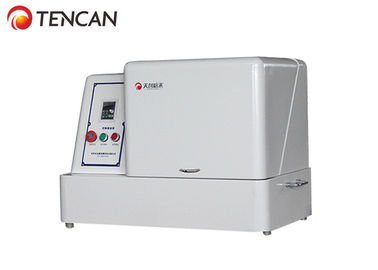
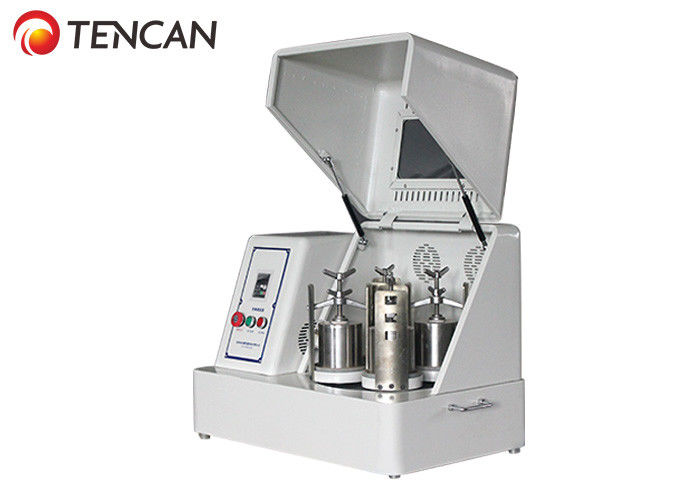
White Square 4L Vertical Laboratory Ball Mill Machine 670rpm Nano Powder
Product Details:
| Place of Origin: | Hunan, China |
| Brand Name: | TENCAN |
| Certification: | CE |
| Model Number: | XQM-4 |
Payment & Shipping Terms:
| Minimum Order Quantity: | 1 set |
|---|---|
| Price: | Negotiable |
| Packaging Details: | Carton+Foam |
| Delivery Time: | 3-7 working days after getting full payment |
| Payment Terms: | T/T,Western Union |
| Supply Ability: | 200 sets per month |
|
Detail Information |
|||
| Product Name: | Vertical Square Type Laboratory Ball Mill | Model No.: | XQM-4 |
|---|---|---|---|
| Total Volume: | 4L | Max Capacity: | 1.32L |
| Rotate Speed: | 70-670 Rpm | Speed Control: | Frequency Controller |
| Voltage: | 220V-50Hz Or 110V-60Hz | Power: | 0.75KW |
| Highlight: | 4L Ball Mill Machine,670rpm Ball Mill Machine,Nano Powder Benchtop Ball Mill |
||
Product Description
China Tencan 4L White Square Shape Vertical Laboratory Micron Scale Ball Mill , Nano Powder Ball Mill Machine
Overview

Vertical square shape laboratory ball mill is a necessary device used for high-tech materials milling, fine grinding, powder mixing, nano powder making, new product development and small batch production. Tencan planetary ball mill owns advantages and features such as small volume, high efficiency, low noise and complete functions. Tencan planetary ball mill is an ideal equipment for R&D institutions, universities, enterprises’ laboratories to get fine powder samples. Tencan planetary ball mill is designed with four working positions and it makes you get four samples (maximum) at one time. you can also use this machine to get powder samples under the vacuum environment if it is equipped with vacuum ball mill jars for grinding.
Working Principle
Vertical square shape laboratory ball mill has four working positions which can be installed with two or four mill jars on one turntable. When the turntable rotates, the jar axis makes planetary movements at high speed, the balls and materials inside the jars are impacted strongly in high speed movement, and materials are eventually ground into fine powder. Various kinds of different materials can be ground by means of dry or wet grinding method. The smallest granularity of output powder can be reached to 0.1μm or nano scale powder.
Applications
Vertical square shape laboratory ball mill is widely applied in industries such as geology, mineral, metallurgy, electronics, building materials, ceramics, chemical industry, light industry, medicine, environmental protection and so on. It is especially suitable for production fields like electronic ceramics, structural ceramics, magnetic materials, lithium cobalt acid, lithium manganese, catalyst, phosphor, long afterglow phosphor, rare earth polishing powder and electronic glass. Powder, fuel cell, Zinc Oxide varistor, piezoelectric ceramic, nano material, wafer ceramic capacitor, MLCC, thermistor (PTC, NTC), ZnO varistor, dielectric ceramics, alumina ceramics, zirconia ceramics, phosphor, zinc oxide powder, cobalt oxide powder, Ni-Zn ferrite, Mn-Zn ferrite and etc.
Features
1. Stable revolving speed of the gear transmission ensures the consistency and repeatability of the experiment.
2. Planetary movement principle is adopted in the machine, which has high speed, large energy, high efficiency, small Granularity.
3. Four powder samples from different sizes and different materials can be produced at one time.
4. The machine is controlled by frequency converter, you may choose ideal rotating speed according to expected experimental result. The converter is equipped with device of under voltage and over-current to protect the motor.
5. The planetary ball mill has functions of timing power off, self-timing forward and reversal rotating. You may choose freely any operation modes of one-way direction, alternation, succession, time setting according to experimental needs, so as to improve efficiency of grinding.
6. Technical features of Tencan Ball Mill: Low center of gravity, stable performance, compact structure, easy operation, reliable safety, lower noise, small loss.
7. Safety switch is installed on the machine to prevent safety accident if the safety cover is opened while machine is running.
Technical Features
| Technical Features | |
| Drive Mode | Gear drive and belt drive |
| Operate Mode | Two or four grinding tanks working together |
| Maximum Loading Capacity | 2/3 of the capacity of milling tank |
| Feeding Size | Soil material≤3mm |
| Output Granularity | Minimum 0.1μm |
| Rotational Speed Ratio | /1/2 |
| Max.Continuous Operating Time | 72hours |
| Materials of Jar | stainless steel.agate,nylon,corundum,zirconia,etc |
Technical Parameters
| Technical Parameters of Vertical Laboratory Mill Ball (SquareType) | |||||||
| Model | Power (KW) |
Voltage | Dimension(mm) | Revolution Speed (rpm) |
RotationSpeed (rpm) |
Total Timing (min) |
Alternating Run Time of Forward & Reversal Rotation (min) |
| XQM-2 | 0.75 | 220V-50Hz | 750*470*564 | 35-335 | 70-670 | 1-9999 | 1-999 |
| XQM-4 | 0.75 | 220V-50Hz | 750*470*564 | 35-335 | 70-670 | 1-9999 | 1-999 |
| XQM-6 | 0.75 | 220V-50Hz | 750*470*564 | 35-335 | 70-670 | 1-9999 | 1-999 |
| XQM-8 | 1.5 | 220V-50Hz | 900*600*640 | 35-290 | 70-580 | 1-9999 | 1-999 |
| XQM-10 | 1.5 | 220V-50Hz | 900*600*640 | 35-290 | 70-580 | 1-9999 | 1-999 |
| XQM-12 | 1.5 | 220V-50Hz | 900*600*640 | 35-290 | 70-580 | 1-9999 | 1-999 |
| XQM-20 | 4 | 380V-50Hz | 1200*750*920 | 25-215 | 50-430 | 1-9999 | 1-999 |
| XQM-40 | 5.5 | 380V-50Hz | 1400*850*1160 | 20-195 | 40-390 | 1-9999 | 1-999 |
| XQM-60 | 7.5 | 380V-50Hz | 1600*990*1250 | 27-174 | 40-260 | 1-9999 | 1-999 |
| XQM-100 | 11 | 380V-50Hz | 1750*1140*1330 | 27-160 | 40-240 | 1-9999 | 1-999 |
Accessories
Available Mill Jars in Full Sizes Matched with Laboratory Ball Mill
Besides the planetary ball mill machine, our factory provides all kinds of mill pots,like stainless steel mill pot, zirconia mill pot, alumina mill pot, nylon mill pot, PU mill pot, tungsten mill pot, hard metal mill pot and tempered nylon mill pot etc. Further, we also provide stainless steel mill balls, zirconia mill balls, alumina mill balls, PU mill balls, steel carbon mill balls,tungsten mill balls, etc.
Available Mill Balls in Full Sizes Matched with Laboratory Ball Mill
We can also provide all kinds of mill balls like stainless steel balls, zirconia balls, alumina balls, PU balls, steel carbon balls, tungsten balls, agate balls, hard metal balls, silicon nitride balls, high wear resistant steel ball, manganese steel balls, nylon balls, cemented carbide, crystal glass and other special metal materials.
Ball-to-Powder Ratio: The Setting Most People Overlook
Most operators focus on speed and time and treat the amount of media as an afterthought, yet the ball-to-powder ratio often decides whether a run works. The ratio compares the weight of the grinding balls to the weight of the material, and on a benchtop mill it usually falls somewhere between about 5:1 and 20:1. A higher ratio gives more contact points and more energy per particle, so grinding is faster and reaches a finer end point; a lower ratio risks the balls being cushioned by too much powder, so the charge simply rolls without breaking down. The catch is that more media also means more wear and more heat, and less room for the sample. On the XQM-4, which holds 4 L with a working charge of about 1.3 L, a useful approach is to fix the jar and sample volume first, then choose the ball weight that fills roughly a third of the jar, and adjust from there.
Process Control Agents: Stopping Cold Welding in Dry Milling
Dry grinding has a problem that wet grinding avoids: freshly exposed metal surfaces can weld together. Soft metals such as aluminium, copper and some alloys are the worst offenders, and instead of breaking down they can ball up and coat the jar walls. The usual remedy is a process control agent, a small amount of a lubricating additive - often only a few percent of the sample weight - mixed in before the run. Common choices are stearic acid, an alcohol or a light surfactant, all of which coat the newly formed surfaces and keep the particles from re-joining. On the XQM-4 the additive is simply added to the jar with the charge. It is a small change that can turn a run producing nothing but agglomerates into one producing fine powder, so it is worth trying early when a metal sample refuses to grind dry.
The Grinding Limit: Why a Powder Stops Getting Finer
It is tempting to think that more time always means a finer powder, but every material has a grinding limit - a point beyond which further milling stops making it smaller. The reason is that the energy added is eventually balanced by the energy fine particles release as they re-agglomerate or weld back together; the mill begins to break clumps apart rather than the primary particles. On a small mill such as the XQM-4 the limit can arrive sooner than expected for soft metals, while hard ceramics often keep refining further. The practical lesson is to characterise the powder as you go rather than running for hours on the assumption that it will keep improving; if the size has stopped falling, more time only adds heat, wear and contamination. Reaching the limit faster is usually a matter of media size and ball-to-powder ratio, not dwell time.
Making Amorphous and Nano-Crystalline Powders by Milling
Grinding is usually seen as a way to make powder smaller, but repeated high-energy impact can also change a material's internal structure. Push a crystalline powder far enough and the crystal lattice can be refined into nano-crystalline grains, and in some cases broken down entirely into an amorphous, glass-like state. These mechanically induced changes are the basis of the whole field of mechanical alloying, where milling causes metals that would not normally mix to combine. The XQM-4 supplies the repeated, high-energy impacts this needs, and because the process depends on accumulated energy rather than a single event, the key variables are speed, time and the energy delivered per impact. Materials such as some oxides, semiconductors and intermetallics are studied this way; the same powder that starts crystalline can end up partly amorphous after a long run.