


 |
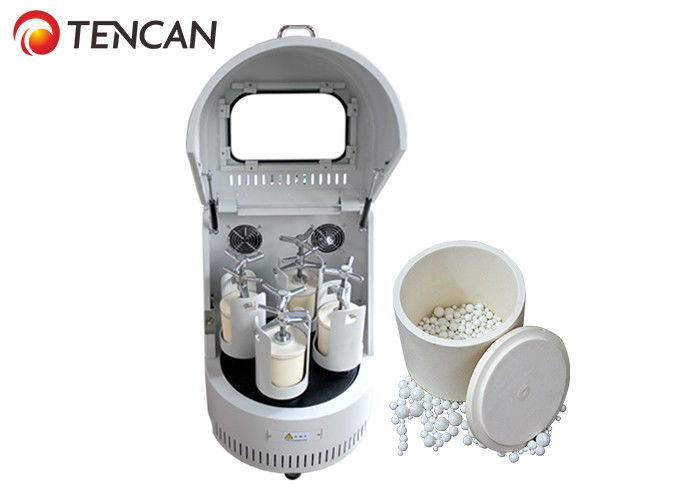
70 - 670rpm Lab Grinding Mill , 2L Laboratory Semi - Circle Vertical Ball Mill
Product Details:
| Place of Origin: | Hunan, China |
| Brand Name: | TENCAN |
| Certification: | CE ISO |
| Model Number: | XQM-2A |
Payment & Shipping Terms:
| Minimum Order Quantity: | 1 set |
|---|---|
| Price: | Negotiable |
| Packaging Details: | Carton+Foam |
| Delivery Time: | 3-7 working days |
| Payment Terms: | T/T,Western Union |
| Supply Ability: | 200 sets per month |
|
Detail Information |
|||
| Product Name: | Semi-Circle Vertical Laboratory Ball Mill | Model No.: | XQM-2A |
|---|---|---|---|
| Total Volume: | 2L | Max Capacity: | 0.66L |
| Rotate Speed: | 70-670 Rpm | Speed Control: | Less Than 60db |
| Voltage: | 110V-60Hz Or 220V-50Hz | Power: | 0.75KW |
| Highlight: | lab ball mill,laboratory ball mill machine |
||
Product Description
2L Volume 220V Or 110V Semi-Circle Vertical Laboratory Ball Mill High Speed Rotation And Good Heat Dissipation
Overview
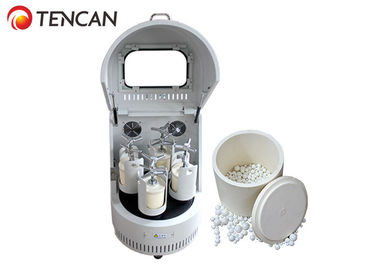
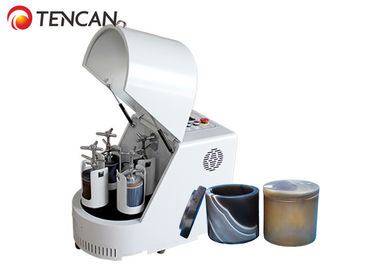
Semi-Circle Vertical Laboratory Ball Mill is a necessary machine used for high-tech materials milling, fine grinding, powder mixing, nano powder making, new product development and small batch production. Tencan planetary ball mill owns advantages and features such as small volume, high efficiency, low noise and complete functions. Tencan planetary ball mill is an ideal equipment for R&D institutions, universities, enterprises’ laboratories to get fine powder samples. Tencan planetary ball mill is designed with four working positions and it makes you get four samples (maximum) at one time. you can also use this machine to get powder samples under the vacuum environment if it is equipped with vacuum ball mill jars for grinding.
Working Principle
Semi-Circle Vertical Laboratory Ball Mill is designed to have four working positions which can be loaded with two or four mill jars on one turntable. When the turntable rotates, the jar axis makes planetary movements at high speed, the balls and materials inside the jars are impacted strongly in high speed movement, and materials are eventually ground into fine powder. Various kinds of different materials can be ground by means of dry or wet grinding method. The smallest granularity of output powder can be reached to 0.1μm or nano scale powder.
Applications
Semi-Circle Vertical Laboratory Ball Mill is widely used in industries such as geology, mineral, metallurgy, electronics, building materials, ceramics, chemical industry, light industry, medicine, environmental protection and so on. It is especially suitable for production fields like electronic ceramics, structural ceramics, magnetic materials, lithium cobalt acid, lithium manganese, catalyst, phosphor, long afterglow phosphor, rare earth polishing powder and electronic glass. Powder, fuel cell, Zinc Oxide varistor, piezoelectric ceramic, nano material, wafer ceramic capacitor, MLCC, thermistor (PTC, NTC), ZnO varistor, dielectric ceramics, alumina ceramics, zirconia ceramics, phosphor, zinc oxide powder, cobalt oxide powder, Ni-Zn ferrite, Mn-Zn ferrite and etc.
Features
1. Stable revolving speed of the gear transmission ensures the consistency and repeatability of the experiment.
2. Planetary movement principle is adopted in the machine, which has high speed, large energy, high efficiency, small Granularity.
3. Four powder samples from different sizes and different materials can be produced at one time.
4. The machine is controlled by frequency converter, you may choose ideal rotating speed according to expected experimental result. The converter is equipped with device of under voltage and over-current to protect the motor.
5. The planetary ball mill has functions of timing power off, self-timing forward and reversal rotating. You may choose freely any operation modes of one-way direction, alternation, succession, time setting according to experimental needs, so as to improve efficiency of grinding.
6. Technical features of Tencan Ball Mill: Low center of gravity, stable performance, compact structure, easy operation, reliable safety, lower noise, small loss.
7. Safety switch is installed on the machine to prevent safety accident if the safety cover is opened while machine is running.
Technical Features
| Technical Features | |
| Drive Mode | Gear drive and belt drive |
| Operate Mode | Two or four grinding tanks working together |
| Maximum Loading Capacity | 2/3 of the capacity of milling tank |
| Feeding Size | Soil material≤3mm |
| Output Granularity | Minimum 0.1μm |
| Rotational Speed Ratio | /1/2 |
| Max.Continuous Operating Time | 72hours |
| Materials of Jar | stainless steel.agate,nylon,corundum,zirconia,etc |
Technical Parameters
| Main Parameters of 2.0L Vertical Semi-circle Round Laboratory Ball Mill | |||||
| Model | Power(KW) | Voltage | Dimension(mm) | Revolution Speed (rpm) | RotationSpeed (rpm) |
| XQM-0.4A | 0.25 | 220V-50Hz 110V-60Hz | 530*300*340 | 45-435 | 90-870 |
| XQM-1A | 0.75 | 220V-50Hz 110V-60Hz | 750*470*590 | 35-335 | 70-670 |
| XQM-2A | 0.75 | 220V-50Hz | 750*470*590 | 35-335 | 70-670 |
Accessories of Mill Jars & Balls
Besides the planetary ball mill machine, our factory provides all kinds of mill pots,like stainless steel mill pot, zirconia mill pot, alumina mill pot, nylon mill pot, PU mill pot, tungsten mill pot, hard metal mill pot and tempered nylon mill pot etc. Further, we also provide stainless steel mill balls, zirconia mill balls, alumina mill balls, PU mill balls, steel carbon mill balls,tungsten mill balls, etc.
We can also provide all kinds of mill balls like stainless steel balls, zirconia balls, alumina balls, steel carbon balls, tungsten balls, agate balls, silicon nitride balls, high wear resistant steel balls, manganese steel balls, and so on.
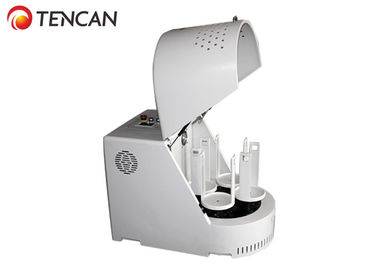
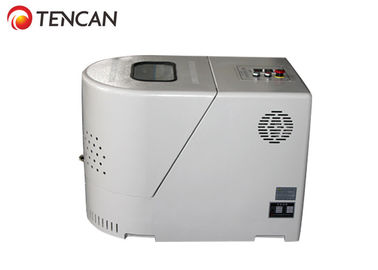
Planetary ball mills are usually box-shaped, and the semi-circle model is the exception. The rounded housing used on the XQM-2A gives the machine a compact, low profile - 750*470*590 mm - that sits neatly on a normal laboratory bench, and the open lines of the cabinet let heat escape more easily than a fully enclosed box. For the user this means a mill that is easy to place, easy to reach around, and simple to keep clean, while still carrying the same four working positions and 2 L total volume as its square counterpart.
High-speed grinding generates heat: the faster the jar turns, the more energy becomes friction between the balls, the jar wall and the sample, and that energy shows up as a rise in temperature. On a 2 L lab mill this matters for two reasons - some materials are sensitive to heat, and a hot machine is harder to run for long periods. The semi-circle cabinet of the XQM-2A is designed to dissipate that heat, which supports longer sessions, including the 72-hour continuous operation the mill is rated for. Even so, the practical approach is to match speed and running time to the sample, and to use interval operation with reversal rather than one unbroken high-speed run when the material is delicate.
The semi-circle series covers three sizes, and the right one is set by batch volume rather than by price. The XQM-0.4A is the smallest and lightest, at 0.25 kW and a 530*300*340 mm footprint, and suits very small sample work; the XQM-1A and the XQM-2A both use a 0.75 kW motor and the same 750*470*590 mm body, differing mainly in usable jar volume and top speed. If the batches are small or bench space is tight, the 0.4 L model is enough; if the work is likely to grow, choosing the larger 2 L version leaves more room for different jars and materials. A common mistake is to size the mill to the first experiment instead of to the range of work it will do over the next few years.
Three settings decide most of the grinding result on the XQM-2A. Speed is set with the frequency converter within the 70-670 rpm range, and matching it to the material - lower for heat-sensitive powders, higher for hard or coarse feed - keeps runs repeatable. Time is set on the timer, which also handles automatic power-off, so runs do not have to be watched. And the direction-reversal function alternates the rotation, which mixes the charge more evenly and avoids the ball pattern settling into a fixed path. Using all three rather than running at one fixed setting is what gives the consistency the mill is built for.
The XQM-2A can be used for both dry and wet grinding. Dry grinding keeps the powder free of liquid and suits materials that must stay dry or would react with a solvent, but it can generate more dust and heat. Wet grinding adds a liquid carrier, which improves dispersion, reduces dust and often reaches a finer particle size, at the cost of a later drying step and the need for a carrier that will not react with the sample. For a new material, a short trial of both routes is usually the quickest way to see which gives the particle size, purity and handling the experiment needs.
The 2 L semi-circle mill is a laboratory tool, and its natural homes are research and teaching. University and institute labs use it for sample preparation and materials research; R&D groups use it for new-material development and small-batch production; and quality-control benches use it to prepare representative samples quickly. Its value in these settings is that it delivers four samples at a time, reaches fine and even nano-scale powder, and is small enough to sit next to the analytical instruments it feeds. Where the requirement moves to continuous, higher-tonnage output, a larger production model is the better fit.
Setting up the XQM-2A is simple: place it on a level bench, connect the working voltage (110 V-60 Hz or 220 V-50 Hz depending on the model), fit the jars and check that they are balanced before the first run. Routine care afterwards is light. Because the drive uses gear and belt transmission, the belts and the moving parts are the items to inspect at intervals, and the jars, seals and grinding media should be checked for wear and kept clean to avoid carry-over between materials. A short start-up run at low speed confirms that the jars are seated correctly and the machine is running smoothly before any valuable sample is loaded.