


 |
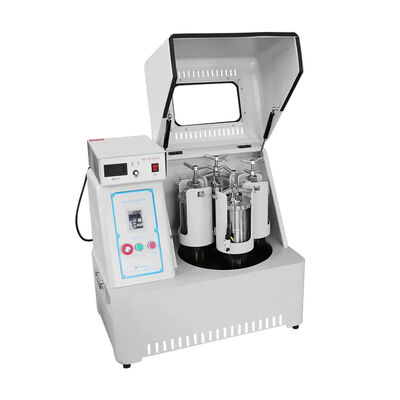
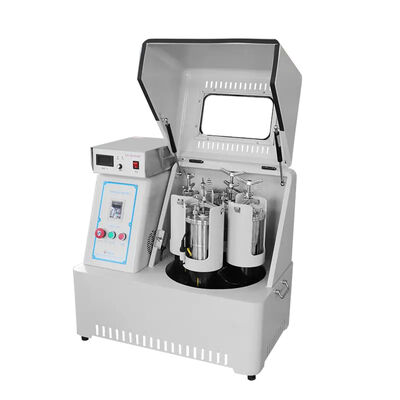
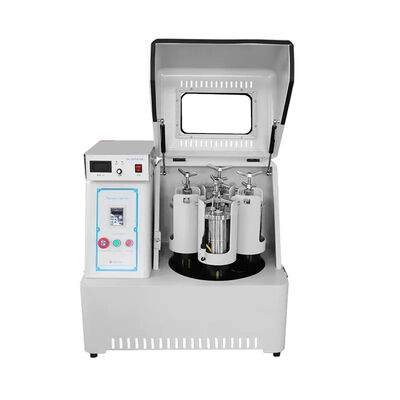
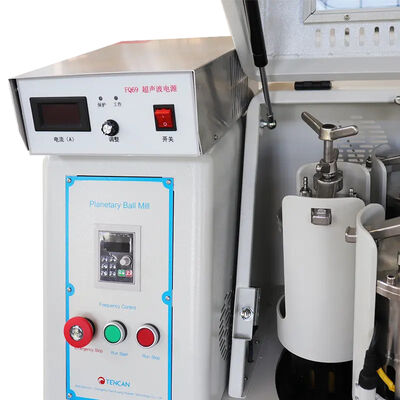
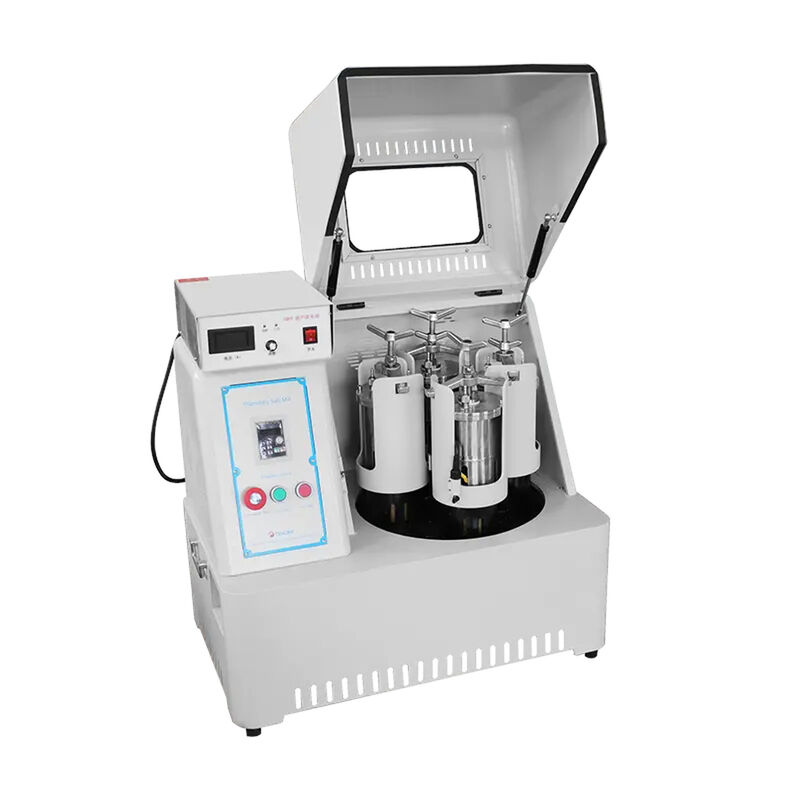
Ultrasonic Planetary Ball Mill XQM Series Anti-Agglomeration Nano Grinding Machine
Product Details:
| Place of Origin: | Hunan, China |
| Brand Name: | TENCAN |
| Model Number: | XQM Series with ultrasonic system |
Payment & Shipping Terms:
| Minimum Order Quantity: | 1 set |
|---|---|
| Price: | Negotiable |
| Packaging Details: | Export packing, to be confirmed per model |
| Delivery Time: | To be confirmed |
| Payment Terms: | T/T |
| Supply Ability: | To be confirmed |
|
Detail Information |
|||
| Product Name: | Ultrasonic Planetary Ball Mill | Transmission Mode: | Gear Transmission |
|---|---|---|---|
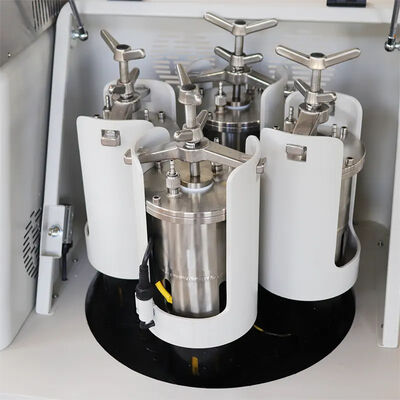
| Working Method: | Two Or Four Jars Simultaneously | Max. Loading Volume: | 2/3 Of Jar Volume (material + Balls) |
| Jar Volume: | 0.5 - 50 L Per Jar; Total 0.2 - 200 L | Feed Particle Size: | Soil Material <=10 Mm; Other Materials <=3 Mm |
| Discharge Particle Size: | Minimum 0.1 Um | Speed Ratio (revolution:rotation): | 1:2 |
| Speed (XQM-6): | 0 - 670 Rpm | Speed Regulation: | Brand Inverter, Stepless |
| Ultrasonic Frequency: | 20 - 40 KHz | Grinding Fineness With Ultrasonic: | 50 - 500 Nm |
| Highlight: | Ultrasonic Planetary Ball Mill,Anti Agglomeration Ball Mill,Nano Powder Grinding Mill |
||
Product Description
Ultrasonic Planetary Ball Mill
Overview
The ultrasonic planetary ball mill is a new generation of high-energy grinding equipment. It is built on the conventional planetary ball mill and adds an ultrasonic oscillation system, so that planetary mechanical grinding and the ultrasonic cavitation and acoustic-flow effects work together. The two energies are applied at the same time to achieve ultra-fine crushing and efficient dispersion in one operation, which addresses the problems conventional ball mills run into when processing micron and nanometre materials: material sinking to the bottom of the jar, agglomeration, sticking to the wall, and secondary agglomeration.

Six advantages of the dual-energy design
By combining the mechanical impact of the ball mill with ultrasonic cavitation, acoustic flow and high-frequency vibration, the machine offers six clear advantages over an ordinary ball mill.
1. Powder agglomeration is suppressed and dispersion greatly improved — the core advantage.
Ultrasonic cavitation collapse generates instantaneous high temperature, high pressure and micro-jets, which break the intermolecular and electrostatic attraction between nanoparticles and disperse them while grinding. Secondary agglomeration, caking, jar-bottom hardening and material sticking to the wall are eliminated after fine grinding. This is particularly suited to materials that agglomerate easily, such as lithium battery materials, rare earth powders, nano-oxides and magnetic powders, where it effectively inhibits agglomeration.
2. Grinding efficiency is raised by 30%-50%, with shorter working hours and lower energy consumption.
Mechanical grinding performs the coarse crushing of particles and the ultrasonic action adds micro-tearing and refinement; the two energies superimpose so that grinding time at the same discharge fineness is cut by one third to one half. There is no need for long no-load dry grinding or repeated feeding to break up agglomerates, which reduces energy consumption and grinding ball loss. The gain is particularly obvious with difficult high-viscosity slurries and paste materials.
3. Finer powder, narrower particle size distribution, higher batch consistency.
Conventional ball milling usually stops at the micron level; with ultrasonic assistance the mill can grind stably to the 50-500 nm nanometre range. Ultrasonic stirring keeps the whole batch moving so that particles receive even grinding time, the D50/D90 span is narrower and powder quality is stable — suitable for precision powders such as MLCC electronic ceramics, polishing powders and pharmaceutical raw materials.
4. A wider material range and compatibility with special conditions.
Material forms: dry powder, aqueous slurry, organic solvent suspension, high-viscosity paste and wet biological material. Special processes: the mill can be used with a vacuum jar and inert gas protection (nitrogen or argon) for powders that oxidise or hydrolyse easily, and some models are fitted with temperature control for heat-sensitive medicines and polymers. Special materials: biological cell wall breaking, catalysts, nano zero-valent iron and phosphors — categories that are difficult to process with traditional ball mills.
5. Less wear and lower impurity contamination.
To break up agglomerates, traditional ball mills have to increase the ball filling and raise the rotation speed, which accelerates wear of the jar and media and introduces metal impurities. Ultrasound disperses through the sound field, so the ball-to-powder ratio and the rotation speed can be reduced. Media wear and the resulting powder contamination drop considerably, and the yield of high-purity powders improves.
6. Easier operation and a friendlier working environment.
The material in the jar stays in suspension and continuous flow, so there is no need to stop the machine, open the lid, scrape the wall or turn the material over mid-run, and automation continuity is better. Models of the same specification are compact and run more quietly than ordinary high-energy ball mills, which suits small-batch research and pilot production: several parallel samples can be produced at once, with four jars grinding simultaneously. Ultrasonic treatment also has a mild activation effect, so grinding can assist solid-phase synthesis and surface modification — grinding and modification in one step, simplifying downstream processing.
Application areas
| Field | Typical uses |
|---|---|
| New energy materials | Ultra-fine grinding and uniform mixing of lithium battery cathode materials (lithium iron phosphate, ternary materials), silicon-carbon anodes and fuel cell catalysts, improving energy density and consistency. |
| Electronic ceramics and functional materials | High-precision grinding of MLCC dielectric materials, piezoelectric ceramics, magnetic materials (ferrite) and rare earth polishing powders, controlling particle size to optimise device performance. |
| Medicine and biotechnology | Micronisation of poorly soluble drugs (to improve dissolution), cell wall disruption and DNA/RNA extraction, where ultrasonic assistance reduces damage to heat-sensitive components. |
| Chemical industry and environmental protection | Catalyst preparation and activation, nano zero-valent iron for wastewater treatment, and dispersion of pigments and coatings. |
| Geology, metallurgy and others | Laboratory sample pre-treatment and ultra-fine crushing of brittle and fibrous materials such as ores, slag, glass and ceramics. |
The machine handles solid particles, suspensions and paste-like materials, and grinds brittle, fibrous and medium-to-low hardness materials well.
Technical parameters
| Transmission mode | Gear transmission |
| Working method | Two or four ball mill jars work simultaneously |
| Maximum sample loading volume | Two thirds of the jar volume (material + grinding balls) |
| Jar volume | 0.5 L - 50 L per jar; total volume 0.2 L - 200 L |
| Feed particle size | Soil material ≤10 mm, other materials ≤3 mm |
| Discharge particle size | Minimum 0.1 µm (varies with material and grinding process) |
| Speed ratio (revolution : rotation) | 1:2 |
| Speed (XQM-6) | Jar rotation speed 0-670 rpm |
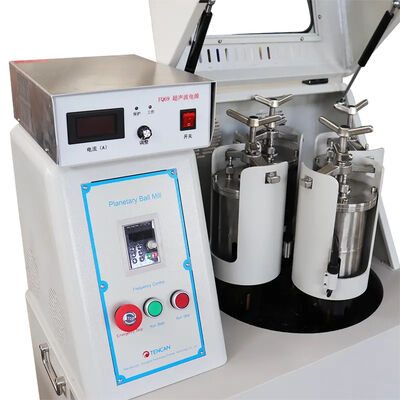
| Speed regulation | Brand inverter, stepless speed regulation |
Working principle
The mill uses a dual crushing mechanism — planetary mechanical grinding plus ultrasonic assisted dispersion — with the two energies superimposed in time and space.
1. Planetary mechanical grinding (macro crushing). The main disk revolves around the central spindle while the jars mounted on it rotate at high speed about their own axes, normally at a 1:2 ratio. This compound motion subjects the grinding balls and material to multi-directional, high-frequency impact, shear and friction: the balls hit the material at very high speed in a strong centrifugal field to break large particles; sliding friction and shear between balls, and between balls and the jar wall, refine the particles further; and the three-dimensional movement inside the jar keeps the material in contact with the media with no dead zones. Material is quickly reduced from the millimetre range to micron and even sub-micron level.
2. Ultrasonic assisted dispersion (microscopic de-agglomeration). The ultrasonic system consists of a generator, a transducer and a conductive slip ring. The generator converts mains electricity into high-frequency electrical oscillation (commonly 20 kHz to 40 kHz); the transducer turns it into mechanical vibration, which is transmitted through the slip ring to the inner wall of the rotating jar and sets up high-frequency mechanical waves in the liquid medium. Two effects follow: the cavitation effect, where the wave alternately tensions and compresses the liquid, forming tiny bubbles that collapse instantly under compression and produce local shock waves of thousands of degrees Celsius and hundreds of atmospheres, breaking up agglomerate structures and preventing secondary agglomeration; and the acoustic flow effect, where the wave drives macroscopic circulation of the liquid, keeping material in motion and preventing dense particles from sinking or adhering to the wall.
3. Synergy. The planetary motion supplies continuous mechanical impact from outside the particle, while the ultrasonic field exerts an anti-agglomeration force from inside, breaking up each agglomerate before it stabilises. Together they shorten the time needed to reach a target particle size, make the discharge particle size distribution markedly more uniform, and bring the minimum discharge size into the nanometre range — a mechanism that conventional ball mills cannot reproduce.
Ordering information
Please confirm the jar volume and the total volume required, the material to be processed and its initial particle size, the target fineness, and whether vacuum or inert gas protection and temperature control are needed. With those details the correct model and jar configuration can be quoted.