


|
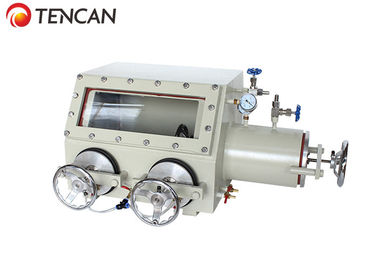
SS Corrosion Resistant Vacuum Glove Box 0.0Mpa 500mm For Chemistry Lab
Product Details:
| Place of Origin: | Hunan, China |
| Brand Name: | TENCAN |
| Certification: | CE ISO |
| Model Number: | GBV-1 |
Payment & Shipping Terms:
| Minimum Order Quantity: | One Piece |
|---|---|
| Price: | Negotiable |
| Packaging Details: | Plywood case with foam |
| Delivery Time: | 25-35 working days after getting full payment |
| Payment Terms: | T/T,Western Union |
| Supply Ability: | 500 pcs per month |
|
Detail Information |
|||
| Product Name: | Stainless Steel Vacuum Glove Box | Model No.: | GBV-1 |
|---|---|---|---|
| Material: | Stainless Steel & PMMA Material | Chamber Szie: | 600*500*500mm |
| Packing: | Plywood Case | Place Of Origin: | Hunan, China |
| Pressure Holding Time: | More Than 12 Hours | Certificate: | CE ISO |
| Highlight: | 0Mpa Vacuum Glove Box,500mm Vacuum Glove Box,Chemistry SS Laboratory Glove Box |
||
Product Description
China Tencan SS Corrosion Resistant Vacuum Glove Box 0.0Mpa 500mm Laboratory Equipment For Chemistry Lab
Overview

Some materials are very sensitive to water and oxygen when doing chemical experiment. So it is hard to finish the research. Although vacuum vessel can satisfy anaerobic and vacuum degree, it is not convenient for operating the procedure. Vacuum glove box solve the environment and operation problem.
The stainless steel vacuum glove box is a laboratory equipment which can be filled with high purity inert gas into the box to filter out the active substances circularly. It is also called glove box, operation box, inert gas protection box, and dry box.
Working Principle
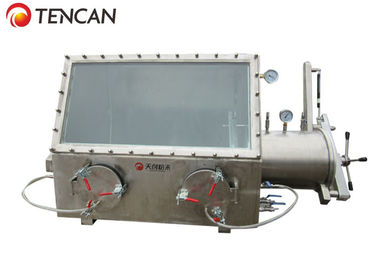
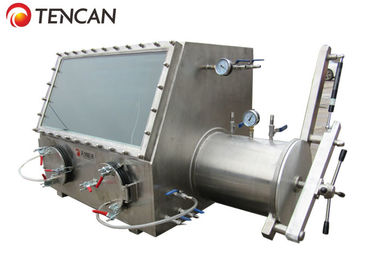
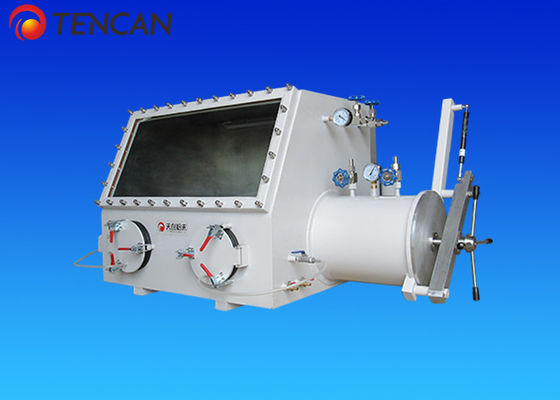
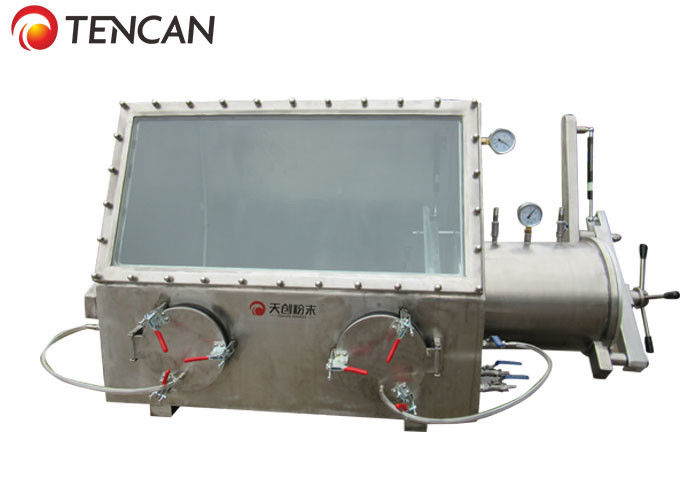
It is mainly composed of main box, transit room and base. If user has special requirement, it can also be customized and designed according to customer needs.There are 2 or 3 glove interfaces. In front of the main box, user can clearly view the inner situation. There is one vacuum ball valve on the main box body. It can be used according to user’s needs. The ball valve can be connected with water faucet when needing water or ventilation. Light bulb can be also installed. Transit room means the transition between the main box and outdoor, composed by two sealed doors, two vacuum ball valves and one room. Two doors isolate main box from connecting with the outdoor, making material putting in and taking out for lab easily.
Features
1. The whole box is made of stainless steel with reinforced plastic and surface spray, it is strong enough with corrosion resistance and easy to be cleaned.
2. The front side of the operating box is made of tempering glass, it has wide angle without dead corner.
3. The interior lighting and the porous socket can be locally heated by the electric stove.
4. The gloves are made of thick latex gloves,well-sealed and durable.
5. The sealing device has the advantages of novel design, reliable sealing and convenient opening;
6. Inside and outside of the box are equipped with water faucet for input of water and gas;
7. The two doors of the transition chamber solve the problems of repeated vacuum extraction for the main box.
Technical Parameters
| Parameters of TENCAN Stainless Steel Vacuum Glove Box | |||||||
| No. | Model No. | Total Dimensions | Box Size | Transition Cabin Size (Optional) |
Left Door Size (Optional) |
Glove Port Size | Vacuum Degree |
| 1 | GBV-1 | 1030*570*530mm | 600*500*500mm | Φ200*280mm | 255*330mm | Φ150mm | -0.1~0.0Mpa Keep vacuum for more than 12 hours |
| 2 | GBV-2 | 1295*715*675mm | 800*650*650mm | Φ273*350mm | 360*480mm | Φ150mm | |
| 3 | GBV-3 | 1755*776*1010mm | 1200*700*950mm | Φ350*400mm | 450*600mm | Φ196mm | |
chemical glove box
main box
chemical glove box
Vacuum vs Gas-Purge Glove Boxes: What the Vacuum Type Does Differently
A glove box keeps a working atmosphere separate from the room around it, but not all glove boxes do it the same way. The common type is purged with inert gas: gas flows through the box and carries the air out, which suits work that needs a dry atmosphere but does not need vacuum. A vacuum glove box such as the GBV-1 works differently. The chamber can be evacuated and refilled, so a deep vacuum and a high-purity inert atmosphere can be reached and held, and the transit room lets samples move in and out through a cycle of evacuation and gas filling. That makes the vacuum type the better fit when parts-per-million levels of oxygen or moisture matter, or when a process must actually run under vacuum rather than simply in dry air.
Reading the Pressure-Hold Figure: What "More Than 12 Hours" Tells You
One figure on the specification sheet deserves attention: the pressure hold. The GBV-1 is rated to keep its vacuum for more than twelve hours, and that single number says a great deal about how well the box is built. A glove box is only as good as its seals - the door gaskets, the glove ports and the valves - and a leak, however small, shows up as a vacuum that fades over time. A box that holds its vacuum overnight will also hold a clean inert atmosphere with little top-up, which is what keeps an experiment stable across a working day. When the box is installed, a simple leak check - evacuating it and watching the gauge - confirms that the seals are doing their job before expensive or sensitive material goes inside.
The Transit Room: Moving Samples In and Out Without Breaking the Atmosphere
The transit room, or antechamber, is the small sealed compartment through the wall of the glove box, and it solves the problem that otherwise defines the whole method: how to get things in and out without letting air in with them. It has two doors and its own vacuum valves; material is placed inside, the outer door is closed, the chamber is evacuated and refilled with inert gas, and only then is the inner door opened to the main box. Doing this properly is what protects the atmosphere, so the habit is to run a full cycle every time, even for a small item. The GBV-1 uses a transit cabin of about 200 x 280 mm, large enough for jars, crucibles, small tools and samples, and its two doors mean the main box does not need to be repeatedly evacuated.
Stainless Steel, Tempered Glass and Latex: Materials for Chemical Work
Every material in a glove box is chosen for a reason, and on the GBV-1 the combination is aimed at chemical work. The body is stainless steel, reinforced and surface-treated so it resists corrosion and can be wiped clean, which suits reactive or corrosive reagents. The front is tempered glass, giving a wide, unobstructed view of the work inside - important when the operator is handling samples through fixed gloves. The gloves themselves are thick latex: flexible enough to work in, tough enough to last, and well sealed at the ports. The seal arrangement around the doors and ports is deliberately simple, so it can be opened and closed often without losing its grip. Together these choices trade nothing decorative for durability where it counts.
Connecting Water, Gas and Power Inside the Box
A glove box is not a sealed jar; it is a small workspace, and the GBV-1 is fitted out accordingly. Water faucets are provided both inside and outside the box, connected through the vacuum ball valve, so a process that needs water or a gas line can be fed without opening the box and breaking the atmosphere. Inside, there is lighting and a porous socket, enough to run a small electric stove for local heating. Used together, these connections let a chemistry procedure - dissolving, drying, heating, reacting - be carried through in place. The practical rule is to plan the gas, water and power lines before starting, so lines are routed and tested on an empty box rather than being added mid-experiment.