


 |
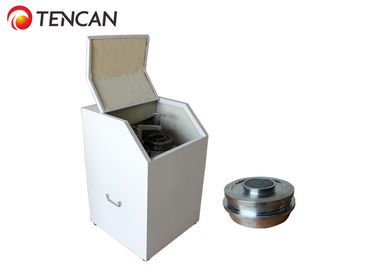
Tencan 380V 200g Minerals Laboratory Sample Grinders With Two Bowls
Product Details:
| Place of Origin: | Hunan, China |
| Brand Name: | TECAN |
| Certification: | CE ISO |
| Model Number: | GJ-2 |
Payment & Shipping Terms:
| Minimum Order Quantity: | 1 set |
|---|---|
| Price: | Negotiable |
| Packaging Details: | Plywood Case+Foam |
| Delivery Time: | 10-15 working days after getting full payment |
| Payment Terms: | T/T,Western Union |
| Supply Ability: | 200 sets per month |
|
Detail Information |
|||
| Product Name: | Lab Sampling Grinder | Model No.: | GJ-2 |
|---|---|---|---|
| Voltage: | 380V-50Hz | Power: | 1.1KW |
| Numbers Of Bowl: | 2 Bowls | Max Capacity: | 200g |
| Feed Size: | Less Than 13mm | Granularity Of Output: | 80-200 Meshes |
| Highlight: | 380V Laboratory Sample Grinders,Minerals Laboratory Sample Grinders,2 Bowls Vibrating Ball Mill |
||
Product Description
China Tencan 380V 200g Output Capacity Minerals Lab Sample Grinder Machine With Two Bowls

Overview
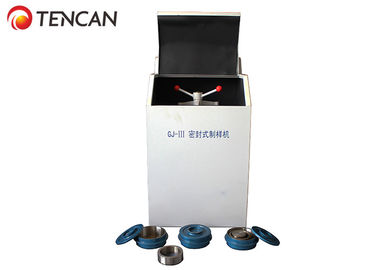
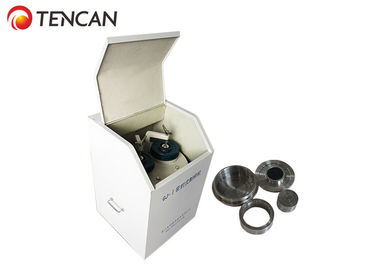
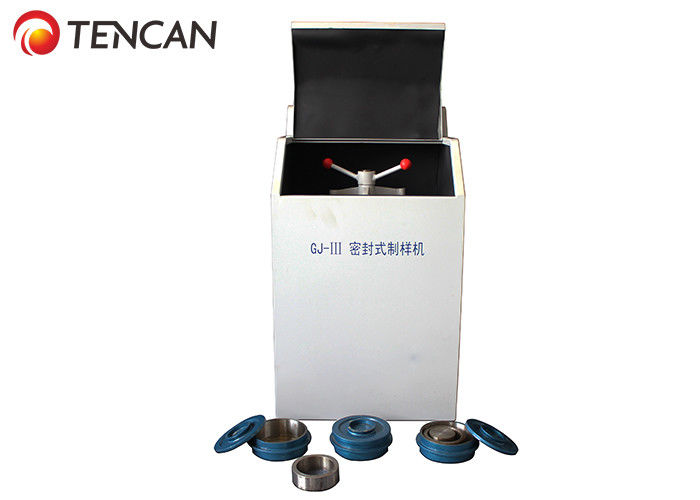
Lab Vibrating sample grinder is also called as sealing type sampling machine laboratory, sealed testing grinder, sealed timing grinder, sealed type pulverizing machine. which is mainly used for powder making of raw materials for laboratory testing. Vibratory sampling grinder is widely used in the industries of coal, coking, non-ferrous metal smelting, mining and other industries. For example, in the fields like coal, coke, gangue, all kinds of ore and so on.
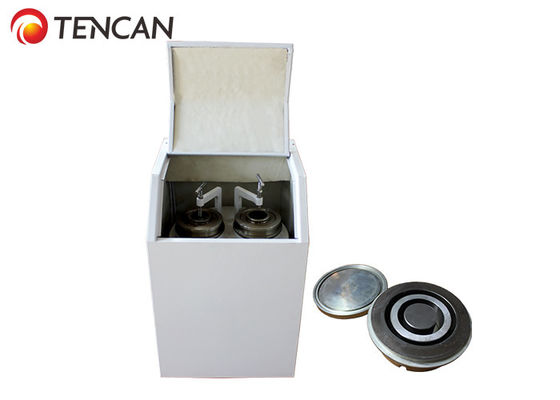
The working mode of vibratory sample grinder: vibratory grinding type. In the bowl, the material is packed in the bowl, and the crushing ring and the crushing hammer are in the bowl. Materials are crushed and milled by the crushing ring and the crushing hammer in the high speed rotation withIn 2-6 minutes, and can be ground quickly into 80-200 meshes (0.175-0.075mm) micron powder samples, which are directly used for testing.
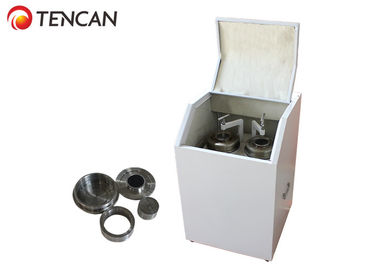
There are several bowls such as normal steel bowl, high manganese steel bowl, wear-resistant alloyed steel bowl, chrome steel bowl and tungsten carbide bowl. Selection of bowl often depends on hardness of material.
Working Principle
The material is placed in a sealed material bowl. There is a crushing hammer and a broken ring in the bowl. The motor drives the eccentric hammer to rotate at high speed. The material is made to be made of powder by vibration impact force and friction force.
Features
1 Output sample is uniform in size, fast in speed, reliable in work and high in grinding efficiency.
2 Output sample can be directly used without sieving, simple process and high efficiency.
3 Reasonable design with full sealing, there is no dust pollution which meets requirements of environment protection.
4 Smooth operation, low noise, it meets requirements of safety production.
5. It is compact in structure, convenient in maintenance and convenient in operation.
6. 1-3 samples can be obtained at one time.
7. Durable and no sample loss because of its good sealing bowls.
8 Electronic timer is optional for the sampling grinder
Two Bowls, Two Samples, One Grinding Cycle
The GJ-2 is the two-bowl model of the TENCAN vibrating sample grinder family: two sealed bowls are mounted on the same machine, so two samples of up to 200 g each are ground at the same time in a single 2–6 minute cycle. For laboratories that prepare a steady flow of powders every day — coal quality inspection, ore grade analysis, coking control and non-ferrous metal smelting — this twin arrangement can almost double the number of ready-to-test samples produced per shift compared with a single-bowl machine. It is equally convenient for grinding the same material twice in one run, either as a duplicate check or as a parallel sample to be sent to a second laboratory for comparison.
Protecting Sample Integrity from One Batch to the Next
Because the bowls are completely sealed during grinding, the finest particles stay inside the bowl from the beginning to the end of the cycle. Nothing is lost as dust and nothing from the previous batch can enter the current sample, which matters when the results of a single 200 g charge decide the value of an entire shipment of ore or coal. When a laboratory moves between very different materials, choosing the right bowl also protects analytical quality: high-manganese steel and wear-resistant alloy steel bowls are preferred for hard ores, while chrome-steel and tungsten-carbide bowls are the usual choice where trace-element analysis demands the lowest possible risk of metallic contamination. Cleaning the bowl and the crushing ring between batches completes the routine.
The Sample Preparation Chain: From 13 mm to Ready-to-Test Powder
The GJ-2 fits into a well-defined position in the laboratory sample preparation chain. Material is first reduced to below 13 mm — typically by a jaw crusher — and is then loaded directly into the bowl. Within 2–6 minutes the vibratory impact and friction of the crushing hammer and ring bring the charge to 80–200 mesh (0.175–0.075 mm), fine enough for most analytical tests without any sieving step. Standardizing the cycle with the optional electronic timer keeps every batch comparable, so the powder prepared today matches the powder prepared last month. The machine is powered by a 380V/50Hz supply with a 1.1 kW motor, and is delivered in a plywood case with foam protection, normally 10–15 working days after full payment; T/T and Western Union are both accepted.
Frequently Asked Questions
- Q: How many samples can the GJ-2 process at one time?
- A: The GJ-2 is equipped with two bowls, each with a maximum capacity of 200 g, and both samples are ground simultaneously in one 2–6 minute cycle.
- Q: Do output samples need to be sieved before testing?
- A: No. The material is ground directly to 80–200 mesh (0.175–0.075 mm) and can be used for testing without sieving.
- Q: What power supply does the GJ-2 require?
- A: The GJ-2 runs on 380V/50Hz with a 1.1 kW motor, and it is also available in the GJ family with 1 or 3 bowls (GJ-1 and GJ-3).
Technical Parameters
| Technical Parameters of Lab Vibrating Sample Grinder | ||||||||
| Model No. | Inlet Size (mm) |
No. of Bowls (pcs) |
Feed Szie (mm) |
Granularity of Output (meshes) |
Capacity (g) |
Power Supply | Dimensions (mm) |
Net Weight (kgs) |
| GJ-1 | 120 | 1 | ≤13 | 80-200 | 100 | 380V/1.1KW | 480*480*730 | 110 |
| GJ-2 | 130 | 2 | ≤13 | 80-200 | 200 | 380V/1.1KW | 480*480*730 | 115 |
| GJ-3 | 130 | 3 | ≤13 | 80-200 | 300 | 380V1.5KW | 530*530*920 | 130 |